
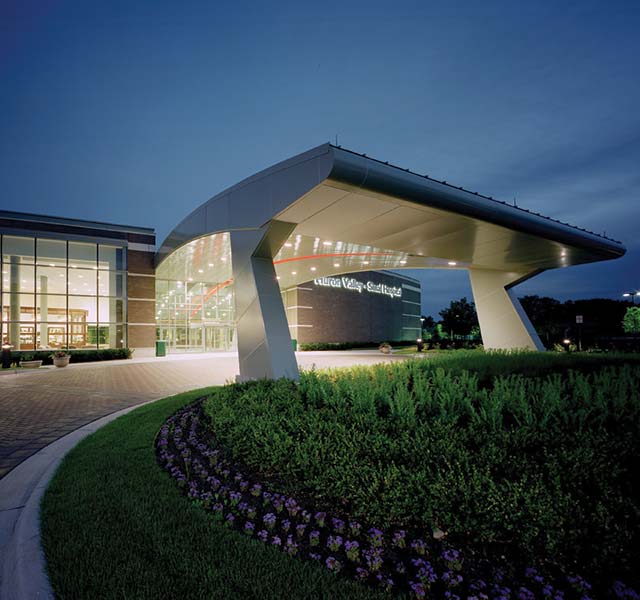



DMC Huron Valley-Sinai Hospital is a full-service community teaching hospital. One of eight hospitals/institutes composing the Detroit Medical Center (DMC), DMC Huron Valley-Sinai Hospital has access to the entire network of DMC physicians and clinical staff.
Founded in 1986 to serve the growing communities of Western and Northwestern Oakland County, Southern Genesee County and Eastern Livingston County, DMC Huron Valley-Sinai Hospital is here to help with all your healthcare needs.
Our Services Include:
- Cancer/Medical and Radiation Oncology
- Cardiac & Pulmonary Rehabilitation
- Cardiology
- Diagnostic Imaging
- Emergency Medicine
- Interventional Radiology
- Neurology/Stroke
- OB/GYN
- Orthopedics/Sports Medicine
- Pain Management
- Pediatrics
- Rehabilitation
- Robotic & General Surgery
- Spine
Building Guides

About Us
Huron Valley-Sinai Hospital features the Emergency Room recently designated as a Level III Trauma Center, 10 Operating Room suites, the Harris Women's Center, a 22-bed unit focused on deliveries and recovering women from surgical procedures, the Charach Cancer Treatment Center with onsite radiation oncology and chemotherapy/infusion clinic and the Pain Management Clinic for therapeutic, interventional and surgical treatment options.
Other core services include comprehensive invasive and non-invasive cardiology services with all surgical procedures except transplant and open heart, 24/7 Neurosurgery coverage, comprehensive inpatient and outpatient diagnostic care and specialty dedicated units featuring one newly redesigned for orthopedics. Obstetrics care includes high-risk pregnancy management, maternal/fetal medicine, complete labor and delivery services and the Special Care Nursery powered by DMC Children’s Hospital of Michigan.
The Spinal Column’s 2022 Best of West Oakland Reader’s Choice Award Winner

Commerce Twp./Walled Lake/Wolverine Lake/Wixom ballot:
- #1 Preferred General Hospital Care for Family
- #1 Preferred Baby Delivery & Birthing Hospital
- #1 Preferred Joint Replacement Hospital
- #2 Preferred Urgent Care Choice
Milford/Highland Twp./White Lake Twp. Ballot:
- #1 Preferred General Hospital Care for Family
- #1 Preferred Baby Delivery & Birthing Hospital
- #2 Preferred Joint Replacement Hospital
Our Services
Upcoming Events
Birthing Class (Virtual/Zoom)
We know pregnancy and the anticipation of labor can lead to a number of questions. Our birthing classes are taught by medi...
Huron Valley-Sinai Hospital
Wednesday, May 1
6:00 PM - 9:00 PM
3 Seats Remaining
Free
- Wednesday, May 1
- 6:00 PM - 9:00 PM
- Huron Valley-Sinai Hospital
- 3 Seats Remaining Register
- Monday, Jun 17
- 6:00 PM - 9:00 PM
- Huron Valley-Sinai Hospital
- 0 Seats Remaining Register
- Monday, Aug 5
- 12:00 PM - 3:00 PM
- Huron Valley-Sinai Hospital
- 12 Seats Remaining Register
- Monday, Oct 7
- 12:00 PM - 3:00 PM
- Huron Valley-Sinai Hospital
- 12 Seats Remaining Register
- Monday, Dec 16
- 12:00 PM - 3:00 PM
- Huron Valley-Sinai Hospital
- 12 Seats Remaining Register
MAY
1
and locations
Hip and Knee Pain Educational Seminar - Dr. Ketner
When joint pain prevents you from doing what you love, lean on our care team. Learn more about non-surgical and surgical t...
Huron Valley-Sinai Hospital Medical Office Building
Wednesday, May 1
6:00 PM - 7:30 PM
35 Seats Remaining
Free
MAY
1
Birthing Class (In-Person)
We know pregnancy and the anticipation of labor can lead to a number of questions. Our birthing classes are taught by medi...
Huron Valley-Sinai Hospital
Monday, May 13
6:00 PM - 9:00 PM
0 Seats Remaining
Free
- Monday, May 13
- 6:00 PM - 9:00 PM
- Huron Valley-Sinai Hospital
- 0 Seats Remaining Register
- Monday, Jul 15
- 6:00 PM - 9:00 PM
- Huron Valley-Sinai Hospital
- 0 Seats Remaining Register
- Monday, Sep 16
- 6:00 PM - 9:00 PM
- Huron Valley-Sinai Hospital
- 8 Seats Remaining Register
- Monday, Nov 18
- 6:00 PM - 9:00 PM
- Huron Valley-Sinai Hospital
- 8 Seats Remaining Register
MAY
13
and locations